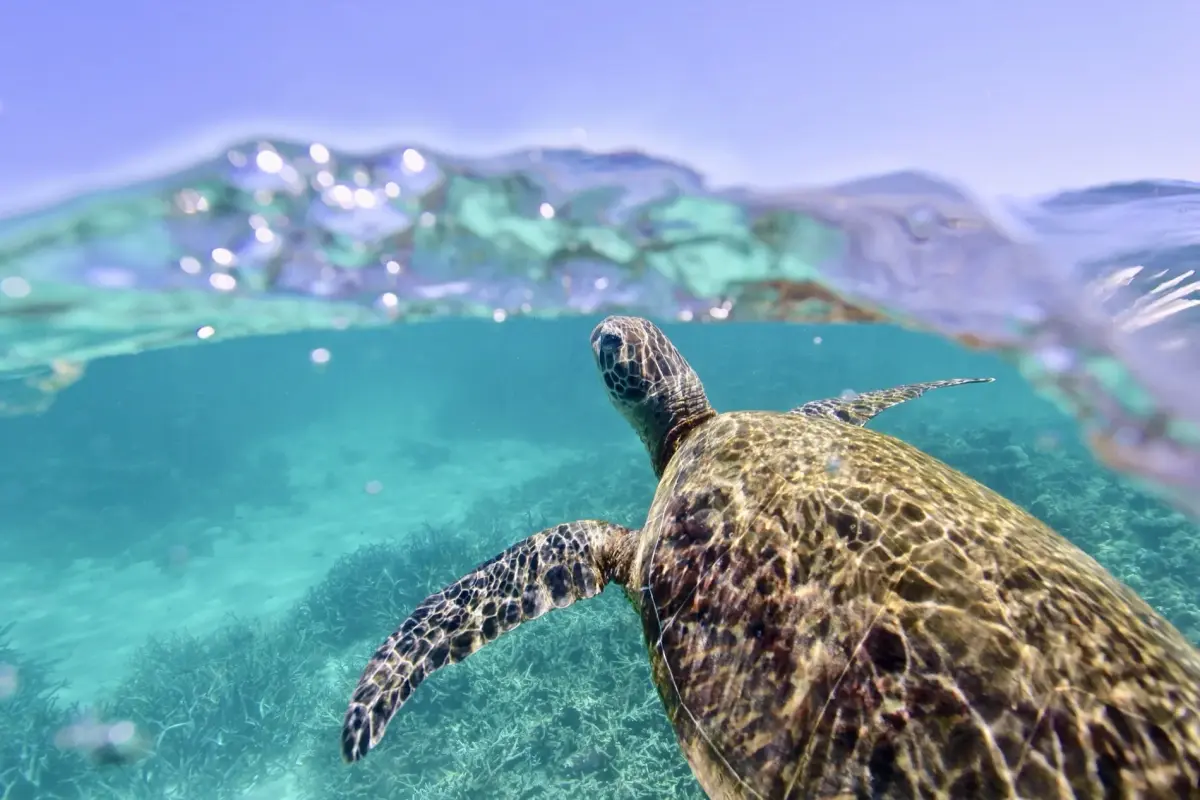
Sea turtles change the rhythm of the ocean around them. Fish stop scattering. Divers slow down. Even confident swimmers begin to move more carefully, trying not to cross the animal’s path. Unlike dolphins, turtles almost never “play” with people. They continue feeding, surfacing for air, resting, or gliding through currents as if humans were not there at all. That calm indifference is exactly why so many travellers become captivated by the idea of swimming beside them.
But not every country offers the same experience.
In some places, turtles appear only occasionally during a snorkeling tour and disappear within seconds. In others, they gather in shallow seagrass lagoons where visibility is high and encounters last long enough to observe the animal’s behaviour rather than simply take a photograph. Some coastlines are known for large green turtles feeding close to shore. Others are known for hawksbills moving slowly through coral reefs, or loggerheads appearing during nesting season.
The best destinations combine several factors at once: a healthy marine ecosystem, stable turtle populations, accessible swimming conditions, and regulations that prevent tourism from damaging the animals’ habitat.
This guide focuses on countries where swimming with turtles is genuinely possible on a regular basis, without requiring expensive expeditions or advanced diving skills. Some destinations are easy tropical beach trips. Others require boats, remote islands, or precise seasonal timing. Each of them can offer a powerful encounter with wild nature when approached with respect.
01Why Turtles Gather in These Places
Sea turtles are not distributed randomly across the oceans. Most well-known places to swim with them exist because the underwater environment suits their lives: seagrass meadows, coral reefs, sheltered bays, and beaches where they can lay eggs.
Green turtles, the species most often seen by snorkelers, feed mainly on seagrass and algae. That is why shallow lagoons in the Maldives or Hawaii often have resident turtle populations. Hawksbill turtles prefer coral reefs, where they feed on sponges and small organisms found between corals. Loggerheads are more often seen near deeper coastal currents.
Water temperature matters as well. Sea turtles live mostly in warm tropical and subtropical waters, which is why many of the best places to encounter them are in Southeast Asia, the Indian Ocean, the Caribbean, and parts of the Pacific.
Once you understand this, the experience changes completely. Turtles stop being just a “tourist activity.” You begin to notice the ecosystems themselves: underwater fields of seagrass marked by feeding traces, coral shelves protected from waves, and channels where currents bring food.
The best places for turtles are almost always excellent snorkeling destinations even without them.
02The Maldives: Calm Lagoons and Reliable Encounters
The Maldives has become one of the most reliable places in the world to swim with sea turtles because of its geography. Thousands of coral islands form sheltered lagoons with warm, shallow water and vast seagrass beds where green turtles feed almost every day.
Unlike destinations where turtles are seen only during special tours, many Maldivian islands have resident turtles living directly beside house reefs. In some atolls, snorkelers can encounter them within minutes of entering the water.
The experience in the Maldives is not built around adrenaline, but around stillness. During the dry season, the water is often so clear that you can observe a turtle calmly from a respectful distance without surrounding it. Hawksbills are especially common near coral walls, while green turtles are often found in sandy lagoons with seagrass.
The Maldives is also surprisingly accessible for people without diving experience. Many encounters happen in water shallow enough for beginner snorkelers.
South Ari Atoll and Baa Atoll are especially known for turtle sightings. Still, the presence of animals changes with the season, currents, and algae growth, which is why knowledgeable local guides matter.
The Maldives also clearly shows one of the main contradictions of marine tourism. Resorts actively use turtles in their marketing, but the survival of turtle populations increasingly depends on limiting tourist pressure. The best operators already enforce distance rules, prohibit touching, and limit the number of boats near feeding areas.
Best Time to Visit
From January to April, the water is usually at its clearest and the sea is at its calmest. From May to November, the ocean becomes rougher and there is more plankton in the water, but turtles remain present year-round.
Best For
Travellers who want calm snorkeling conditions, warm water, island stays, and a high chance of seeing turtles without complex diving.
03Indonesia: Reef Diversity and Truly Wild Encounters
Indonesia offers one of the most varied turtle-swimming experiences in the world because the country covers enormous marine ecosystems across thousands of islands.
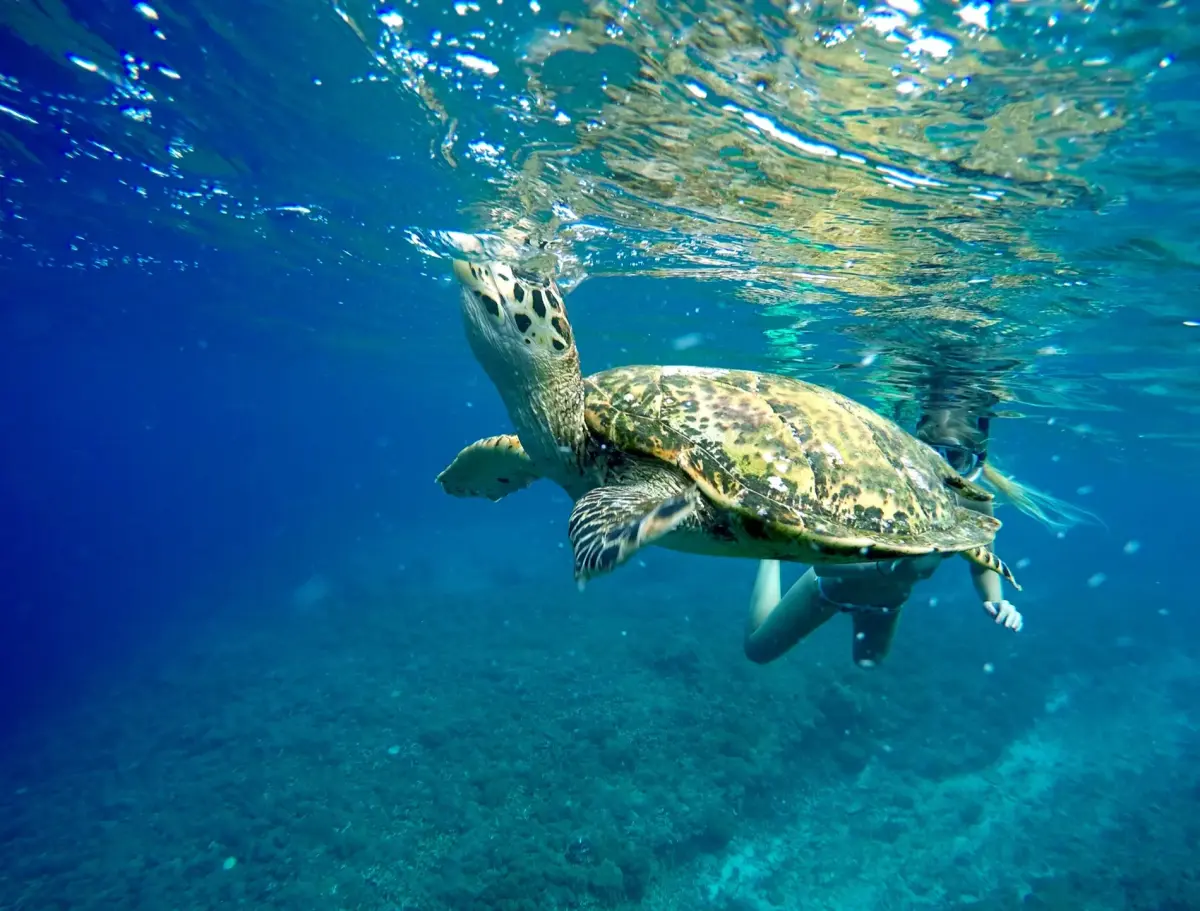
Around the Gili Islands, turtles come incredibly close to shore. Green turtles often rest directly on shallow coral platforms, where they can be observed with very little effort. The water is usually calm, which is why the Gili Islands have become one of the most famous places for turtle snorkeling.
But the most impressive encounters in Indonesia often happen beyond the most popular islands.
In Raja Ampat, hawksbill turtles move through reefs considered among the most biodiverse on Earth. In Komodo National Park, turtles drift through strong currents beside reef sharks and manta rays. Around Nusa Penida, mola mola appear seasonally, while turtles can be seen almost year-round.
Indonesia’s greatest strength is not only the number of turtles, but the scale of the surrounding nature. Many encounters here feel genuinely wild rather than built into tourist infrastructure.
Conditions vary greatly by region. Some places are suitable for beginners, while others have strong currents and require confident swimming.
Best Time to Visit
In general, the best period is from April to October, when there is less rain and the sea is calmer, although eastern Indonesia follows slightly different seasonal patterns.
Best For
Travellers who care about islands, coral reefs, and the feeling of a real marine adventure.
04Hawaii: Volcanic Landscapes and Protected Green Turtles
Hawaii is one of the few places where sea turtles are woven into local culture rather than existing only as a tourist attraction.
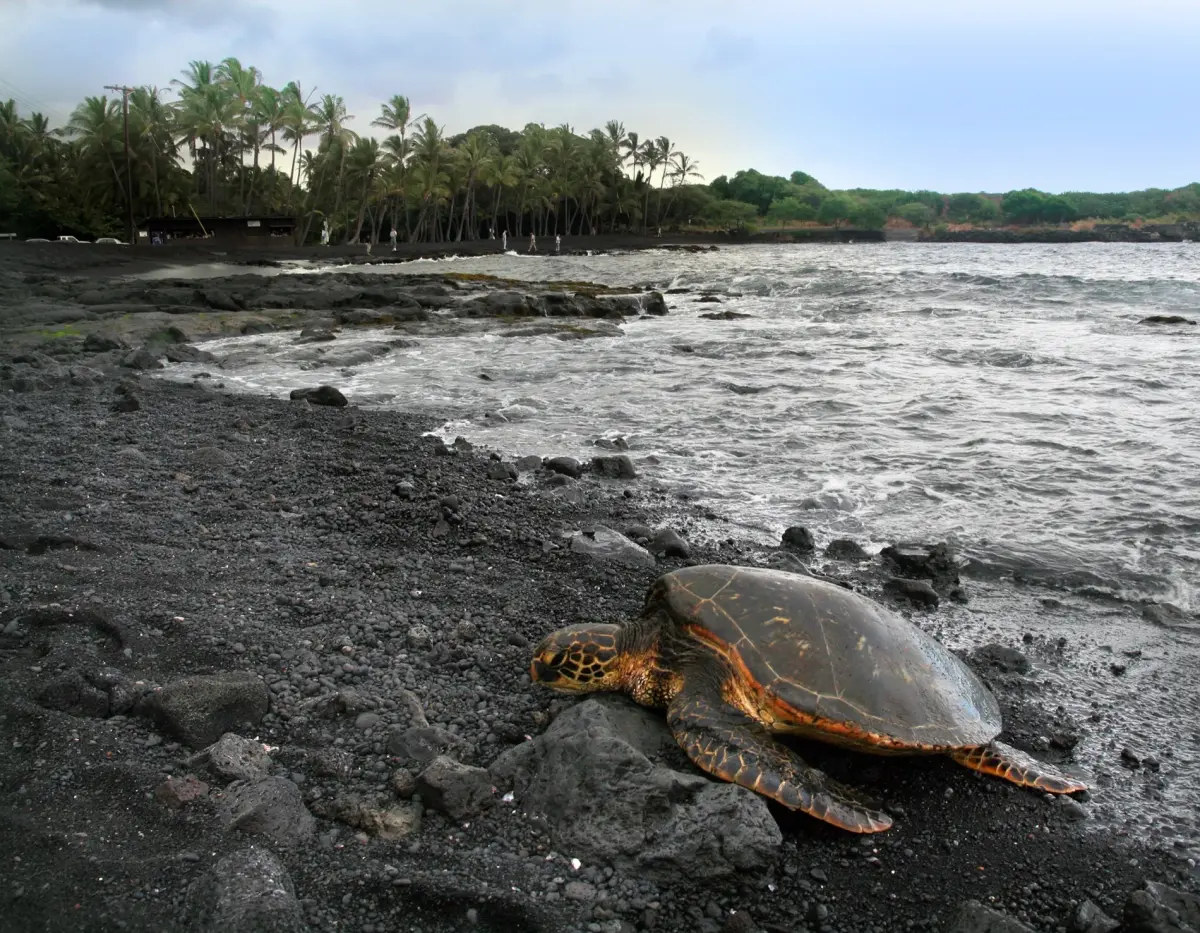
The Hawaiian green turtle, known locally as honu, is found around almost all the islands, especially near volcanic shores covered with algae. Unlike many tropical countries with lagoons and white sand, Hawaii’s underwater landscapes feel more dramatic: black lava shelves, underwater arches, and deep blue drop-offs.
On Maui, turtles are often seen near Makena Landing and Maluaka Beach. On Oahu, they regularly appear in North Shore coves and near Electric Beach. Some beaches have even become turtle resting areas, where turtles haul out onto the sand.
Wildlife protection laws here are genuinely strict. Approaching turtles, trying to touch them, or blocking their path to the surface can result in serious fines. Rangers and conservation organisations actively explain the rules to visitors.
This visibly affects the animals themselves. In many Hawaiian bays, turtles remain calm around people precisely because aggressive tourist behaviour is less tolerated here.
Best Time to Visit
Turtles can be seen year-round. In summer, the ocean is usually calmer for snorkeling.
Best For
Travellers who want to combine beaches, volcanoes, hiking, and marine life in a destination with strong infrastructure and a serious conservation culture.
05Australia: The Great Barrier Reef and Turtle Migrations
Australia is one of the most important countries in the world for sea turtles. Six of the seven existing sea turtle species can be found here.
The best-known encounters happen along the Great Barrier Reef, where green turtles, hawksbills, loggerheads, and flatback turtles live among reefs stretching for more than 2,300 kilometres.
Australia’s main difference is the scale of the ecosystem. Swimming with turtles here often becomes part of a much larger marine experience: coral walls, migrating whales, reef sharks, and huge schools of fish.
Some islands are major nesting sites. Around Lady Elliot Island, turtles can be seen almost year-round directly in shallow lagoons.
Australia also shows what marine tourism connected to science and ecology can look like. Many tours include explanations about turtle migration, threats to coral reefs, and rising ocean temperatures.
But not every country offers the same experience.
Best Time to Visit
From June to October, the weather is usually more comfortable and underwater visibility is good. Nesting seasons vary depending on the species.
Best For
Travellers who care not only about seeing turtles, but about understanding the whole marine ecosystem.
06The Philippines: Accessible Turtle Encounters
The Philippines has gradually become one of the best destinations for swimming with turtles on a moderate budget.
In Moalboal, green turtles feed directly near the shore in water suitable even for beginner snorkelers. This place has become especially popular because a turtle encounter does not require an expensive tour: you can simply enter the water from the beach.
On Apo Island, marine sanctuaries support healthy coral reefs with large turtle populations. Around El Nido, turtles appear among limestone islands and lagoons.
The Philippines is especially popular with long-term travellers. Compared with the Maldives or Hawaii, accommodation, transport, and tours are much cheaper, while marine life remains very rich.
During typhoon season, however, conditions can worsen quickly.
Best Time to Visit
The best season is usually from December to May, when there is less rain and underwater visibility is better.
Best For
Travellers who want a good balance between budget, islands, and quality snorkeling.
07Costa Rica: Turtles and Wild Ecosystems
Costa Rica is known mainly for sea turtle nesting rather than snorkeling, but some regions allow travellers to experience both.
Olive ridley turtles, green turtles, leatherbacks, and hawksbills can be found along the country’s Pacific and Caribbean coasts.
Around Tortuguero National Park, night tours allow visitors to observe turtles coming ashore to lay eggs. Snorkeling is less developed here than in countries with vast coral reefs, but turtle encounters still occur near reefs and volcanic coastal areas.
Costa Rica’s greatest strength is context. Here, turtles become part of a larger journey through jungles, cloud forests, mangroves, and volcanoes.
Costa Rica helped shape much of the modern understanding of ecotourism.
Best Time to Visit
Seasons depend strongly on the turtle species and the specific coast. Nesting periods vary.
Best For
Travellers who care not only about the ocean part of the trip, but about the entire wildlife ecosystem.
08How to Swim With Turtles Responsibly
The popularity of turtle tourism has already created serious pressure on some ecosystems. In certain places, turtles have begun changing their behaviour because tourists constantly chase them. Others are injured by boats or by people coming too close.
A good turtle encounter depends greatly on human behaviour.
The best operators today follow simple rules: keep distance, avoid flash photography underwater, never block the animal’s path to the surface, and limit group sizes.
Touching turtles is especially harmful. Their shells contain nerve endings and a natural bacterial layer that can be damaged by repeated contact. Chasing a turtle also forces it to waste energy needed for feeding and migration.
The best encounters usually happen when a person simply stops trying to control the situation.
The turtle continues living its own life, and that is exactly what makes the moment so powerful.
09How to Choose the Right Turtle-Swimming Destination
It is better to choose a country for swimming with sea turtles not by social media photographs, but by the kind of experience you want to have in the water.
In the Maldives, everything is built around calm: warm lagoons without waves, clear water, and turtles that can often be seen right beside a resort’s house reef. This destination suits travellers who want to swim without stress, spend a long time in the water, and quietly observe the animals.
Indonesia feels different. Here, variety matters more than comfort. One day you can swim with turtles near a small island with currents and coral walls; another day, you can find yourself among enormous reef systems where turtles become part of a much larger marine world. That is exactly why experienced snorkelers and divers love Indonesia.
Hawaii brings together the ocean, volcanic landscapes, and a very strict approach to wildlife protection. Here, swimming with turtles feels less like a tourist show and more like entering a local natural environment. Australia offers a completely different scale: long reef systems, migrations, several turtle species, and the feeling of an immense living ocean. The Philippines has become one of the best options for travellers who want a strong marine experience without a Maldives-level budget. Costa Rica is better suited to those for whom turtles are part of a larger journey through jungles, volcanoes, and wild nature.
Expectations matter here as well.
Some travellers want an island where they can walk into the water from the beach and almost immediately see a turtle below the surface. Others deliberately seek remote reefs, boat expeditions, and places where encounters happen less often but feel more wild. For some people, underwater photography becomes the main goal. Others simply want to float quietly in warm water beside a slowly feeding green turtle and watch for a few minutes as it moves through the seagrass.
These are completely different types of trips, even though they are technically about the same animal.
That is why sea turtles are so memorable. They do not deliberately interact with humans, and they do not create the feeling of an “attraction.” They are migratory animals following their own routes inside a vast marine ecosystem. A person is only briefly allowed to be near them — and that may be the greatest value of these encounters.
10Next Articles
- Best Places to Swim With Turtles in the Maldives
- Best Places to Swim With Turtles in Indonesia