China’s high-speed rail network has changed the way people travel across the country. Distances that once required overnight trains or domestic flights now take an hour or two. A traveller based in Shanghai can have breakfast beside futuristic skyscrapers, lunch near classical gardens hundreds of years old, and dinner beside canals that have carried boats for centuries.
This makes Eastern China particularly rewarding for slow travel. Rather than treating Shanghai as a base and repeatedly returning to it, the region reveals itself more naturally when travelled as a sequence. The landscape, architecture, food, and rhythm of daily life change gradually from city to city. The route feels less like a collection of destinations and more like a continuous journey.
Over the course of a month, it is possible to move from Shanghai’s glass towers to Suzhou’s gardens, from water towns lined with stone bridges to tea-growing hills around Hangzhou, then onward into the mountains of Anhui Province before finishing among the historic streets of Nanjing. The distances are short, the logistics are simple, and the transitions feel surprisingly natural.
The result is one of the most satisfying rail journeys in Asia.
01Shanghai: Beginning Slowly
Most international visitors arrive in Shanghai, and many underestimate how much time the city deserves.
Shanghai is often presented through photographs of Pudong’s skyline. The towers are impressive, but they tell only part of the story. The city’s appeal comes from its layers. Colonial-era buildings line the Bund. Plane trees shade the former French Concession. Traditional lilong lane houses survive between modern developments. Small restaurants, bakeries, tea shops, and markets occupy streets that rarely appear in guidebooks.
Spending ten to fourteen days here is not excessive. After a long international flight, Shanghai provides space to adjust. It is easy to navigate, public transport is excellent, and almost every district feels different from the next.
Mornings are particularly revealing. Local residents practise tai chi in parks, walk their dogs, exercise beside rivers, or gather around breakfast stalls serving fresh jianbing, steamed buns, and soy milk. These daily routines often leave a stronger impression than the famous landmarks.
Shanghai also works well as a gentle introduction to contemporary China. Before heading into smaller cities and rural landscapes, visitors gain confidence using trains, payment systems, metro networks, and navigation apps.
Most importantly, Shanghai provides context. The cities that follow make more sense once you have spent time in the country’s largest urban centre.
02Suzhou: Gardens, Canals and Quiet Details
The journey to Suzhou takes little more than half an hour by high-speed rail.
The speed of the transition is remarkable. One moment you are in one of the world’s largest metropolitan areas. Shortly afterwards, you are walking through narrow lanes beside canals where stone bridges connect neighbourhoods that have existed for generations.
Suzhou is internationally known for its classical gardens. Many were created by scholars, officials, and wealthy families during the Ming and Qing dynasties. Rather than displaying wealth through size alone, these gardens were designed as carefully composed landscapes.
Rocks were selected for their shape. Pavilions framed specific views. Windows were placed to reveal particular scenes. Water reflected trees, walls, and changing light throughout the day.
The Humble Administrator’s Garden remains the city’s most famous example. Yet smaller gardens often leave equally strong impressions because they reveal how carefully space was organised. Nothing appears accidental.
Outside the gardens, Suzhou rewards unstructured wandering. The historic Pingjiang Road district follows an ancient canal lined with tea houses, bookstores, cafés, and residential buildings. Boats still move through the waterways, although far less frequently than in previous centuries.
Evenings are especially pleasant. After day visitors leave, the streets become quieter. Reflections from lanterns and shop lights shimmer across the water. Conversations drift from open windows. The atmosphere feels residential rather than theatrical.
Two days is usually enough to appreciate Suzhou without rushing.
03Wuzhen: Staying After the Crowds Leave
Many travellers visit a water town as a day trip. Wuzhen is one of the places where staying overnight changes the experience completely.
Water towns developed throughout the Yangtze River Delta because canals functioned as transport routes long before roads became dominant. Wuzhen preserves many of the architectural characteristics associated with these settlements: whitewashed walls, dark-tiled roofs, stone bridges, wooden buildings, and narrow canals running directly through the town.
During the middle of the day, the streets can become busy. Tour groups move through the main areas, and popular viewpoints attract photographers.
The atmosphere changes dramatically in the evening.
As shops begin closing and day visitors depart, the pace slows. Lanterns illuminate bridges and waterside buildings. The canals become quieter. The sounds of conversations, footsteps, and moving water replace the noise of large groups.
Walking through Wuzhen after dark reveals why spending a night here is worthwhile. The town stops feeling like a destination and starts feeling like a place where people actually live.
An overnight stay allows time to experience both evening and early morning, which are often the most memorable parts of a visit.
04Hangzhou: Tea Hills and Life Around the Lake
From Wuzhen, the journey to Hangzhou takes little more than an hour. The change in scenery is subtle at first. Canals gradually give way to wooded hills, larger expanses of water, and a landscape that has inspired poets, painters, and scholars for centuries.
For many Chinese travellers, Hangzhou is one of the country’s most liveable cities. It combines the amenities of a major urban centre with an environment that encourages people to spend time outdoors. While Shanghai often feels energetic and fast-moving, Hangzhou feels noticeably calmer.
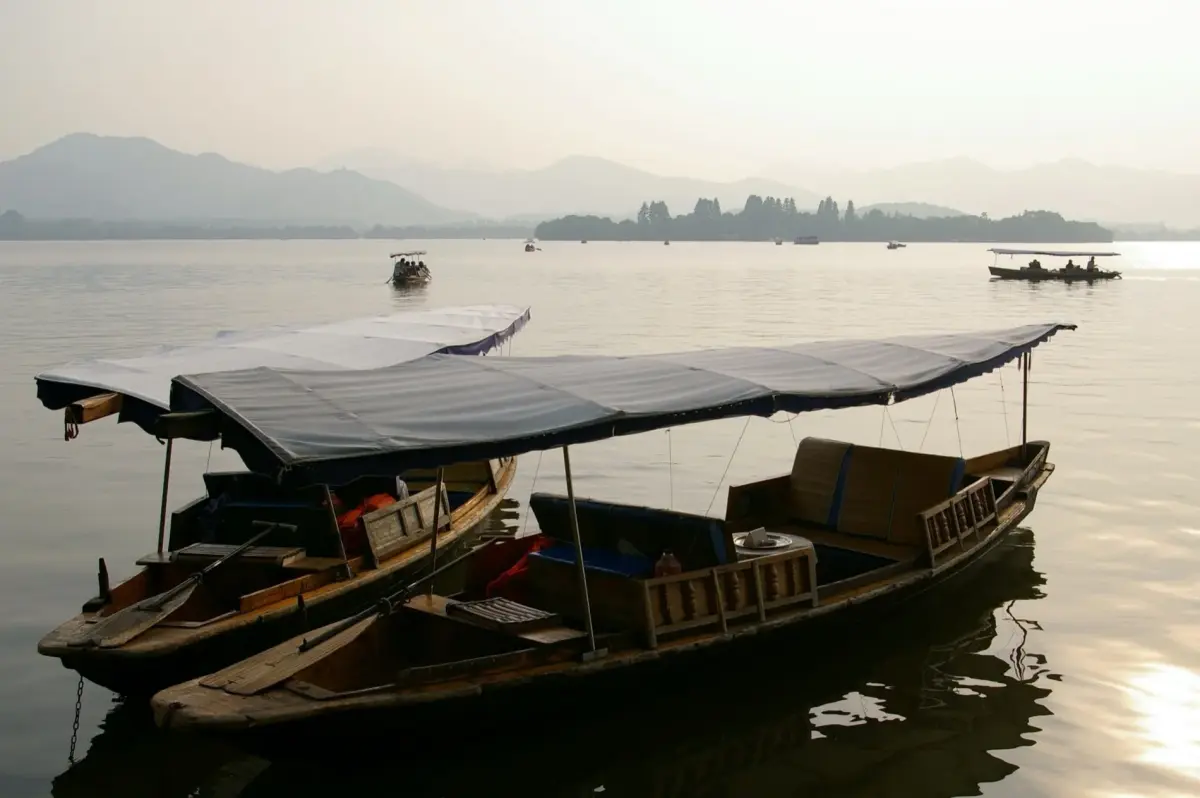
The city’s identity is closely tied to West Lake. Covering more than six square kilometres, the lake sits at the heart of Hangzhou, surrounded by causeways, pagodas, gardens, wooded slopes, and historic sites. It has been celebrated in Chinese literature for over a thousand years and remains one of the most visited scenic areas in the country.
Yet the appeal of West Lake is not limited to famous viewpoints. Much of its charm comes from ordinary moments. Elderly residents gather for morning exercises beneath willow trees. Cyclists follow shaded paths along the shoreline. Small boats drift across the water as mist lifts from the hills.
The lake changes character throughout the day. Early mornings are often the quietest, especially outside peak holiday periods. By late afternoon, soft light reflects across the water, while evenings bring locals out for walks along the promenades.
Beyond the lake lies another side of Hangzhou that many visitors miss.
The hills southwest of the city contain the tea-growing villages of Longjing, one of the most famous green tea regions in China. Narrow roads wind through terraces of carefully maintained tea bushes. Farmers move between rows carrying baskets during harvest periods, while small family-run tea houses welcome visitors throughout the year.
Longjing tea, often known internationally as Dragon Well tea, has been cultivated in this region for centuries. Unlike darker teas that undergo oxidation, Longjing is pan-fired shortly after picking, preserving its green colour and distinctive flavour. The result is a tea known for gentle nutty notes, freshness, and a clean finish.
Visiting the tea villages is not simply about tasting tea. It is an opportunity to understand how deeply tea remains connected to daily life in China. Families continue to cultivate small plots, tea houses serve local varieties produced only a short distance away, and conversations often unfold slowly over multiple cups.
Four or five days in Hangzhou rarely feel excessive. The city rewards a slower pace. Some mornings are best spent walking beside the lake. Others belong to tea villages, quiet temples, museums, or simply sitting beneath trees watching local life unfold.
After the water towns and historic gardens of Jiangsu Province, Hangzhou introduces a different side of Eastern China: one shaped by landscape, agriculture, and traditions that remain visible in everyday life.
This makes Eastern China particularly rewarding for slow travel. Rather than treating Shanghai as a base and repeatedly returning to it, the region reveals itself more naturally when travelled as a sequence. The landscape, architecture, food, and rhythm of daily life change gradually from city to city. The route feels less like a collection of destinations and more like a continuous journey.
05Huangshan: Mountains Above the Clouds
The rail journey from Hangzhou to Huangshan takes approximately two to three hours. Once again, one of the strengths of travelling through Eastern China becomes clear. Distances that appear substantial on a map often require less time than a journey across many large cities elsewhere in the world.
Huangshan, known in English as the Yellow Mountains, is among the most celebrated mountain landscapes in China.
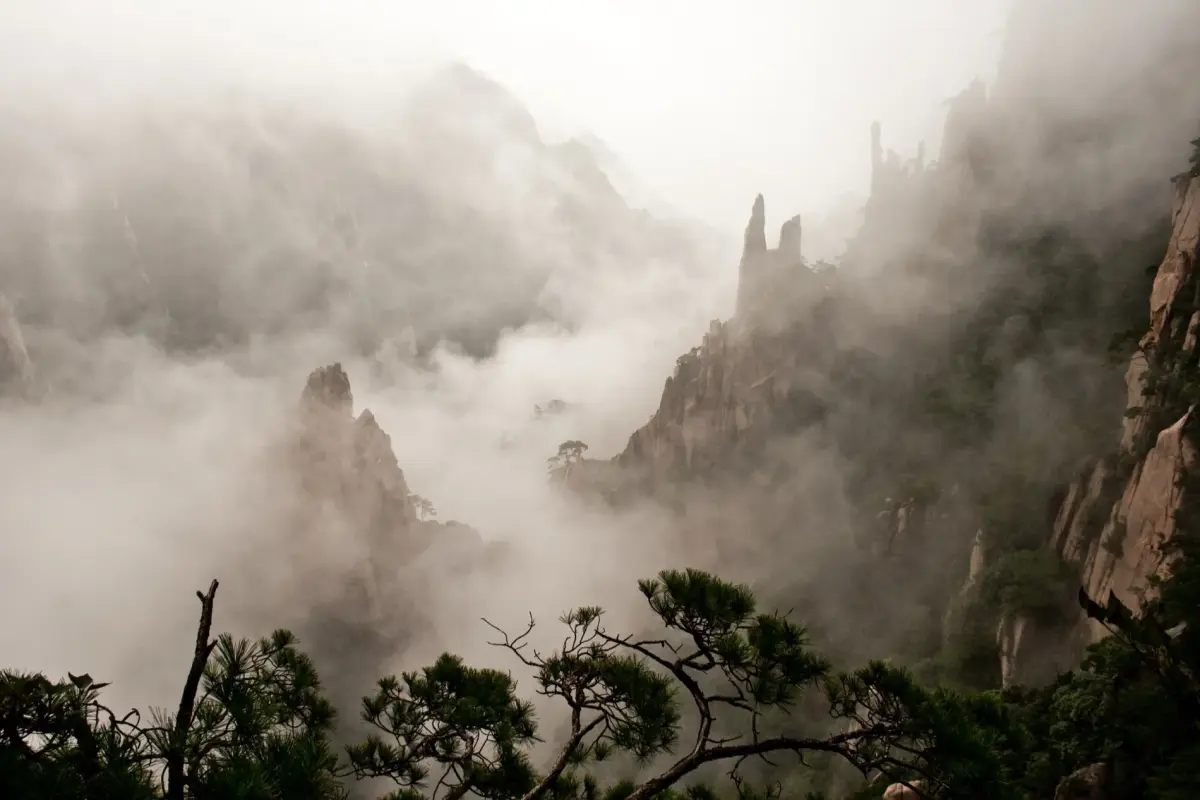
Its reputation is not based on height alone. Many mountain ranges around the world are taller. What distinguishes Huangshan is the combination of granite peaks, ancient pine trees, steep cliffs, changing weather, and cloud formations that frequently fill the valleys below.
The scenery has influenced Chinese painting for centuries. Many of the mountain landscapes that appear in traditional scroll paintings draw inspiration from places like Huangshan. Visitors who arrive on a foggy morning often recognise these scenes immediately.
The mountains reward patience more than speed.
Weather plays a significant role in the experience. A clear day reveals distant ridges and dramatic rock formations. Mist transforms familiar viewpoints into something entirely different. Peaks emerge and disappear as clouds move through the valleys. Conditions can change several times within a single day.
This is why spending multiple days in the region is worthwhile.
Many visitors arrive in the afternoon, stay overnight either within the mountain area or nearby, and dedicate at least two full days to exploring the trails. Early mornings are especially valuable. Before large groups arrive, pathways are quieter and conditions are often ideal for viewing cloud formations.
The famous pine trees of Huangshan deserve particular attention. Some grow directly from seemingly impossible positions on exposed cliffs. Over centuries, harsh conditions have shaped them into forms that appear almost sculpted.
Yet Huangshan is not only about mountains.
Nearby villages such as Hongcun and Xidi provide a very different perspective on the region. Both preserve traditional Anhui architecture characterised by white walls, dark roofs, narrow lanes, decorative gateways, and carefully planned water systems.
Hongcun in particular is known for the ponds and canals integrated into the village layout. Reflections of historic buildings ripple across the water, while residents continue daily routines much as they have for generations.
The contrast between mountain landscapes and traditional villages makes the region particularly rewarding. A traveller can spend one day climbing among granite peaks and the next wandering through streets shaped by merchants during the Ming and Qing dynasties.
Four to five days allows enough flexibility to accommodate weather while experiencing both sides of the region.
The reward is one of the most memorable landscapes in China.
06Nanjing: History Woven Into Everyday Life
After several days among tea hills, mountain trails, and traditional villages, Nanjing feels like a return to urban life. Yet it is a very different experience from arriving in Shanghai.
The train journey from Huangshan takes approximately two and a half to three and a half hours. The transition works particularly well within the rhythm of this itinerary. By this stage, travellers have already experienced modern China, canal towns, tea-growing landscapes, and mountain scenery. Nanjing brings those experiences back into an urban setting while adding another important layer: history.
Few Chinese cities have played as many significant roles in the country’s past.
Nanjing served as the capital of multiple dynasties and governments over the centuries. Its strategic location on the Yangtze River helped shape its importance, while its political role left behind a remarkable concentration of historic sites, monuments, temples, walls, and cultural institutions.
Yet what makes Nanjing particularly appealing is that it rarely feels like an open-air museum.
The city remains a living place first.
Students fill university campuses. Commuters move through modern metro stations. Families gather in parks during the evening. Restaurants serve regional Jiangsu cuisine to local residents rather than primarily to visitors. History exists everywhere, but it remains integrated into daily life rather than separated from it.
One of the city’s defining landmarks is the Ming Dynasty City Wall. Constructed during the fourteenth century, large sections remain intact today. Walking along the wall provides a perspective that few modern cities can offer. Ancient fortifications overlook contemporary neighbourhoods, highways, lakes, and skyscrapers, creating a visual reminder of how many different periods of Chinese history overlap within the same urban landscape.
Purple Mountain offers another dimension to the city. Covered with forests and walking trails, it contains several important historical sites, including the Mausoleum of Sun Yat-sen and the Ming Xiaoling Mausoleum. The area is particularly beautiful in spring and autumn, when changing colours soften the landscape and encourage long walks beneath the trees.
In the evening, many visitors gravitate towards the Confucius Temple district. Although undeniably popular, the area remains one of the most atmospheric parts of the city after dark. Traditional-style buildings line canals illuminated by lanterns. Food stalls, small restaurants, and local shops create a lively but manageable atmosphere.
Compared with Shanghai, Nanjing often feels less overwhelming. The city is large, but its pace is noticeably calmer. Distances are easier to understand, crowds feel less intense, and neighbourhoods reveal themselves gradually rather than demanding attention all at once.
Three to four days provides enough time to explore the major historical sites while still leaving room for unplanned discoveries. Nanjing rewards curiosity. Some of its most memorable moments emerge not from famous attractions but from quiet streets, lakeside paths, university districts, and neighbourhood restaurants encountered between destinations.
By the time many travellers leave Nanjing, they begin to recognise how much their understanding of China has expanded since arriving in Shanghai several weeks earlier.
07Returning to Shanghai
The final rail journey takes little more than an hour.
Returning to Shanghai after travelling through Eastern China creates a surprisingly different experience from the one that greeted most visitors at the beginning of the trip.
The skyline is unchanged. The metro remains efficient. The streets are just as busy as before.
Yet the city now feels familiar.
The tea culture encountered in Hangzhou, the canal towns of the Yangtze Delta, the villages of Anhui Province, and the historical layers of Nanjing provide context for what initially seemed like a purely modern metropolis. Shanghai begins to feel less isolated and more connected to the wider region that surrounds it.
For this reason, it is worth reserving one or two final days before departure.
There is no need to fill them with major sightseeing.
A final walk through the French Concession. A long lunch in a neighbourhood restaurant. An afternoon exploring independent shops. Time to revisit a favourite café discovered during the first week. These simple activities often become an important part of concluding a long journey.
Travelling continuously for a month can be surprisingly demanding. Even when trains are comfortable and distances are short, new impressions accumulate quickly. A final pause in Shanghai allows time to process the journey before returning home.
08Why This Route Works So Well
Many itineraries attempt to cover as much territory as possible. They prioritise famous landmarks, long checklists, and rapid movement between destinations.
Eastern China rewards a different approach.
The strength of this route comes from its gradual progression.
Shanghai introduces contemporary urban China. Suzhou reveals the elegance of classical gardens and canal-side neighbourhoods. Wuzhen slows the pace even further through the atmosphere of a traditional water town. Hangzhou introduces tea culture and landscapes shaped by centuries of cultivation. Huangshan shifts attention towards nature, weather, and mountain scenery. Nanjing reconnects history with modern life before the journey returns to Shanghai.
Each destination prepares the traveller for the next.
The route avoids major backtracking. Train journeys remain short. Hotels do not change every day. There is enough time in each place to develop familiarity rather than simply collect photographs.
Most importantly, the journey mirrors the rhythm of Eastern China itself.
Urban skylines gradually give way to canals. Canals lead towards tea-covered hills. Hills rise into mountains. Mountains descend into historic cities. The final return to Shanghai completes a circle that feels coherent from beginning to end.
What remains afterwards is not a memory of individual attractions but a deeper sense of place. The traveller leaves with an understanding of how landscapes, cities, traditions, and daily life connect across one of China’s most fascinating regions.
That is what makes this route feel less like a holiday and more like a journey.
What makes this route particularly rewarding is the way each destination naturally prepares you for the next.
Shanghai → Suzhou → Wuzhen → Hangzhou → Huangshan → Nanjing → Shanghai
The journey begins in contemporary China, surrounded by skyscrapers, high-speed trains, and one of the world’s largest cities. From there, the pace gradually slows as you move into Suzhou’s classical gardens and historic canals. Wuzhen continues that transition, replacing busy city streets with stone bridges, narrow waterways, and evenings shaped by the rhythm of a traditional water town.
The landscape then opens into the tea-growing hills surrounding Hangzhou, where daily life revolves around lakes, villages, and one of China’s most celebrated tea cultures. From there, the route climbs into the mountains of Huangshan, where granite peaks, ancient pine trees, and shifting seas of cloud create some of the country’s most iconic scenery.
Nanjing brings the journey back into an urban environment, but one where history remains visible in city walls, temples, and neighbourhoods shaped by centuries of political and cultural importance. Finally, the return to Shanghai allows travellers to see the city with new perspective, understanding how it connects to the landscapes, traditions, and communities that define the wider region.
Rather than feeling like a collection of separate destinations, the route unfolds as a continuous journey through the many layers of Eastern China.